Removing moss, algae and lichen from clay tiles, concrete tiles and natural slate, with care for the gutters, the garden and the roof itself
Roof cleaning in Meerhout tends to come up sooner than people expect. Houses here often sit among pine and birch, and a north-facing roof can stay damp for days after rain. Moss settles between the tiles first, then algae spreads a green or black film over the rest. Before anything else we find out what your roof is made of, since clay tiles, concrete tiles and natural slate each need different handling. Then the moss comes off, the roof gets rinsed and the gutters are emptied. If you have fibre-cement sheeting laid before 2001, we'll tell you plainly that we won't clean it, and explain the rule behind that.
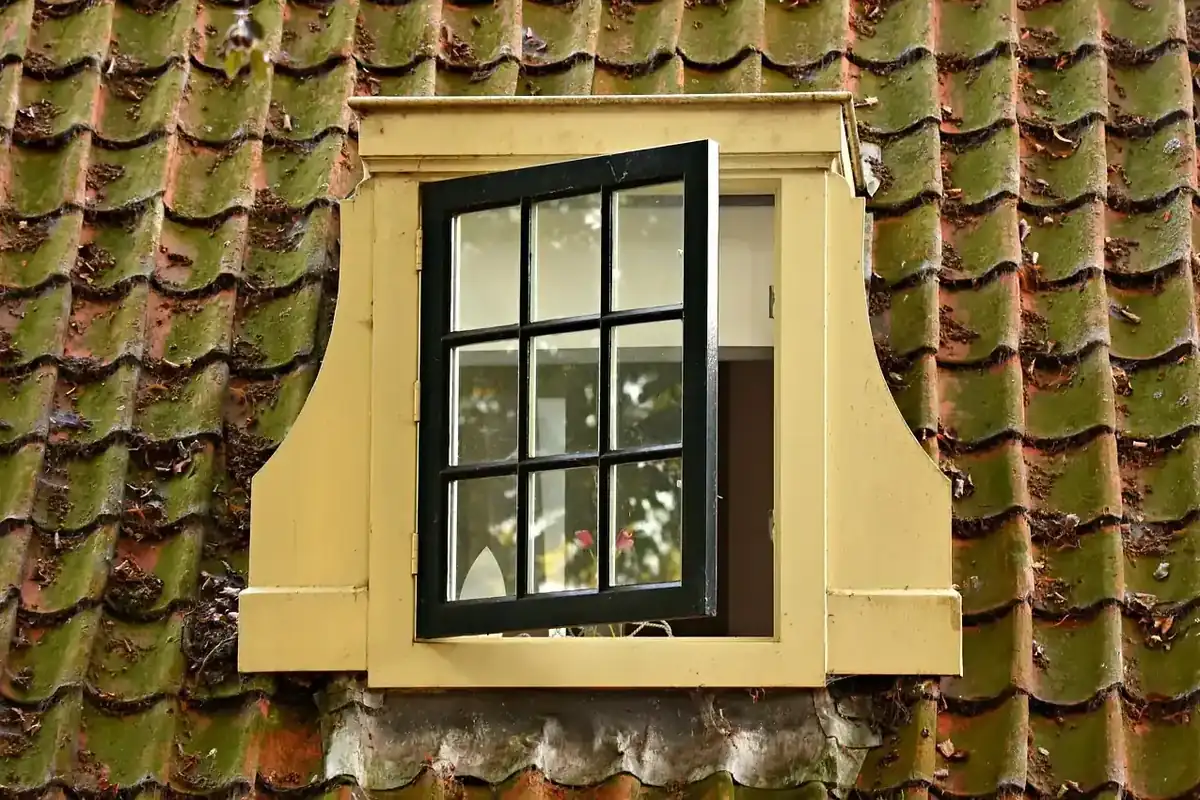
Ask us to price your roof
- 1Call or email with your address
- 2A photo of the roof helps
- 3We send a quote, no obligation
Ring or email with what needs cleaning and where you live. A photo of the surface lets us size up the job before we come out.
- Free quote
- No obligation
- We look before we price
- Roofs, patios, drives, walls
- English & Nederlands
Why bother
What roof cleaning in Meerhout gets you, and what it can't
Looks are the least of it. Most of the reasons to clear a roof have to do with water and where it ends up.
A roof that dries out
Moss fills up with rainwater like a bath sponge and lets go of it slowly, so the tiles underneath stay wet while the rest of the garden has dried. Clear it and the roof gets a chance to dry out between showers.
Less for frost to work on
When water soaked into a porous tile freezes, it expands. Over enough winters that can mean hairline cracks or a flaking surface. A roof that dries quicker gives frost less to work with.
Gutters that drain
Every heavy downpour washes loose clumps of moss into the gutters, where they block the outlet and the water spills down the wall instead. Once the roof is done we clear the gutters and check the downpipe runs freely.
Handled to suit the material
Glazed clay tiles can take more than old concrete ones, whose surface turns powdery with age. Natural slate is thin and can crack under a careless foot. Pressure and brushes are chosen with that in mind.
Damage you can finally see
A mat of moss hides a cracked tile or a slipped slate. Once the roof is clean, both show up, and we'll point out anything we noticed so you can decide what to do about it.
It will come back
A roof under trees will green over again in time, and how fast depends on shade, aspect and the kind of tile. A treatment after cleaning can slow the regrowth, but nothing stops it for good.
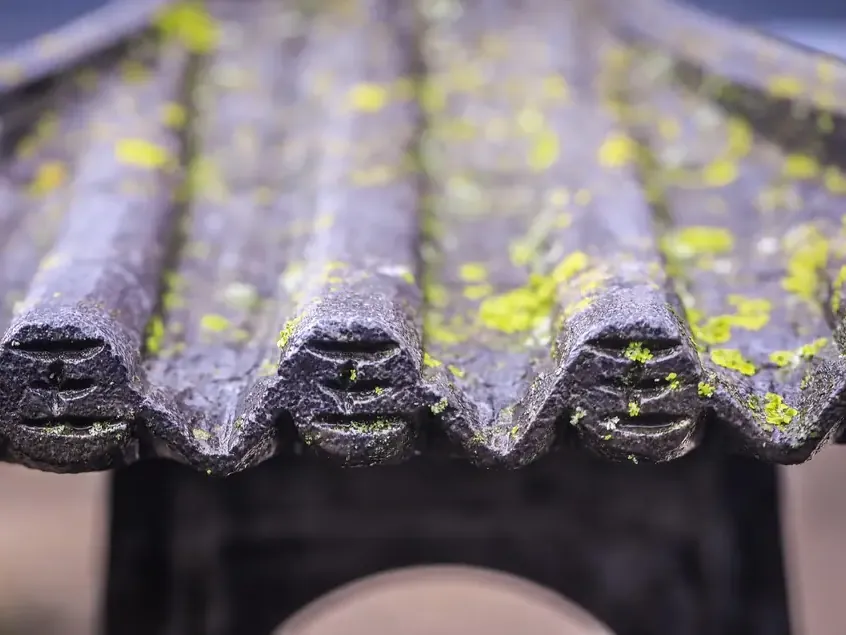
Roof types
Why we check what your roof is made of first
Clay tiles are fired, often glazed, and stand up well to careful cleaning. Concrete tiles are another matter: the coloured surface wears thin over the years, and a heavy jet strips away what's left. Natural slate is laid in thin overlapping courses, so the work there is gentle and the weight on the roof kept low. Then there are the fibre-cement slates and corrugated sheets still found on older houses, garages and farm buildings. If they went on before 2001 they may contain asbestos, and Flemish rules forbid cleaning or de-mossing any roof or wall clad in asbestos-containing material. We leave those roofs alone.
- We identify the roof covering first
- Pressure set for tile or slate
- Gutters and downpipes cleared afterwards
- Plants and paving below the eaves covered
- No cleaning of asbestos cement, which the law forbids
How it works
How a roof clean goes, start to finish
Roofs get cleaned in dry weather. We'll agree a date with you and move it if the forecast turns.
- 01
Get in touch
Ring us or drop us an email. Your address and a couple of photos tell us roughly how big the job is and whether there's anything awkward to plan around, such as solar panels, a dormer or a flat section.
- 02
A look at the roof
On site we confirm the roofing material and check its condition. If it looks like old fibre cement, you'll hear that straight away, along with the suggestion to have an asbestos expert check it. If not, a quote follows, and you're free to say no.
- 03
Protecting the house
Downpipes are covered so moss doesn't end up in the drains, and plants, windows and paving under the eaves get sheeted over. Moving the car down the road for the day saves it from splashes.
- 04
Moss off, roof rinsed
Heavy moss is lifted off first, working down from the ridge. The tiles or slates are then rinsed at a pressure that suits them, and where it makes sense an anti-growth treatment follows.
- 05
Gutters and handover
Last of all, the loose moss comes out of the gutters and we check the water runs away. We'll tell you about anything we spotted along the way, such as a broken tile, a loose ridge tile or a slate out of place.
- →
Over to you
Ring or email us with a couple of photos of what needs cleaning. Quotes are free and there's no obligation.
Get a quote →
Questions
Roof cleaning in Meerhout: your questions
Can you clean my old fibre-cement roof?
If it was laid before 2001, most likely not. Fibre-cement slates and sheets from that era can contain asbestos, and in Flanders it's against the rules to clean or de-moss a roof or wall made from asbestos-containing material, because doing so releases fibres. So we won't work on it. An asbestos expert can tell you exactly what you've got. Newer fibre cement is a different matter, and we can talk it through.
Why do roofs in the Kempen get so mossy?
Moss needs damp and shade, and this area has plenty of both. Lots of homes stand among pine, birch or oak, and needles and leaves collect between the tiles and hold water. A north-facing slope gets almost no winter sun. A roof in full sun with no trees nearby usually stays clean much longer.
Won't a pressure washer damage the tiles?
It can, if the pressure is too high or the nozzle too close. Older concrete tiles lose their surface, and water forced up under the tiles can get inside. That's why pressure and angle are set for each roof, and the jet always runs with the overlap of the tiles, never against it.
Which time of year suits roof cleaning?
During a dry spell outside the frosty months. A wet or frosted roof is dangerous to work on, and an anti-growth treatment needs some dry hours to soak in. Spring and early autumn often work well, though in the end that week's forecast decides.
Do I need to be home?
Not necessarily. We need access to the garden or drive, and it helps if windows and roof lights are shut. On a terraced or semi-detached house it's worth a word with the neighbours too, as their gutter or patio may catch some spray.
Service area
Roof cleaning around Meerhout
We set out from Meerhout to clean roofs in Geel, Mol, Balen and Laakdal, and just as often in Westerlo, Herentals and Kasterlee. Tessenderlo and Diest, just across the provincial lines, are on our list too.
- Meerhout
- Geel
- Mol
- Balen
- Laakdal
- Westerlo
- Herentals
- Kasterlee
- Tessenderlo
- Diest
Curious what's under all that moss?
Give us a ring or an email with your address and, if you can, a photo of the roof. We'll tell you how we'd tackle it and what it would cost.